


Should You Try to Time the Market?
Basketball coach Tim Notke said, “Hard work beats talent when talent doesn’t work hard.”
It meant to teach his athletes to be consistent in their hard work. In many ways, consistency for investors is also the key to success. Many investors feel torn: is now the “right” time to buy, or should I wait for something better? The truth is, it’s impossible to predict market moves correctly and consistently. Missing just a few of the market’s best days can have a huge impact on long-term performance. Here’s what research shows, and what tends to work better.
Missing the Best Days = Big Opportunity Costs
- A July 2025 study from Wells Fargo looked at the S&P 500 over the past 30 years (1995-2025). They found that if you missed the top 30 best trading days, your annualized return fell drastically — from ~8.4% down to ~2.1%. Missing even more “best days” (40-50) dropped returns essentially to zero or negative. Wells Fargo Advisors
- A 2025 Vanguard study ran an analysis where a hypothetical $100,000 invested in the S&P 500 from 1988 to 2024 would have become ~$4.9 million if fully invested the whole time. Yet if you missed just the 10 best days, it would drop to ~$2.3 million; missing 20 best days → ~$1.4 million; missing 30 → ~$900,000. Vanguard Advisors
These studies show that a small number of very good days drive a lot of total returns, and trying to avoid volatility can also cause you to miss out on big gains.
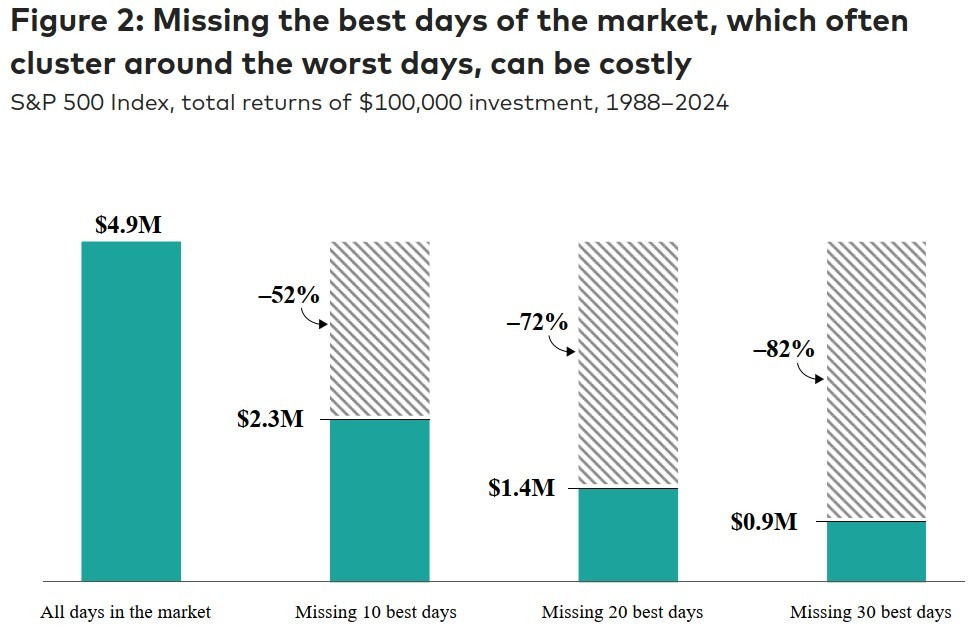
Source: Vanguard Investment Advisory Research Center calculated data from Standard & Poor’s. As of December 31, 2024
Note: Return percentage calculated over a 37-year period: 11.1% = all days in the market, 8.9% missing 10 best days, 7.3% missing 20 best days, 6.0% = missing 30 best days.
Timing the Market: Harder Than It Sounds
- Unpredictability & market cycles: The basic dilemma is that markets move based on many factors such as macroeconomic trends, interest rates, policy, and world events to name a few. Predicting long term trends is hard, predicting short term trends is nearly impossible. Investopedia+2CAIA+2
- Transaction costs, taxes, and emotional bias destroy returns. Even if you could got lucky with good entry/exit points, trading costs, hidden expense, missing out on holding benefits like lower taxes and dividends and often eat away at gains. Investopedia+1
- Studies of “bad timing vs. good timing” show that even large deviations from “buy & hold” strategies often don’t pay off enough to justify the risk. You have to perfectly time the peak and then know exactly when the bottom hits. Nobel Memorial Prize winner Paul Samuelson as well as studies such as Charles Schwab’s 2024 five investment styles, validate the axiom “time in the market is better than timing the market.” They point out that making regular investment contributions at steady intervals will outperform holding out for larger investments at the right time. AQR Capital Management+2CAIA+2
Why a Steady, Disciplined Approach Usually Wins
- Time in the market matters more than trying to get in at the perfect moment. Staying invested allows growth, compounding, and capturing those “best days.” CapitalGroup
- Dollar-cost averaging (investing at regular intervals regardless of how the market looks) helps smooth out volatility and reduces the risk of investing a large sum at a bad time.
- Diversification portfolio encompassing a manageable number of individually owned stocks aligned with your goals may be the best approach for a total return.
What to Take Away
- Trying to time the market is tempting. Everyone wants to avoid downturns and jump in before upswings. Many may hold out for months if not years waiting for the perfect time.
- Missing just a few of the best market days can severely erode your long-term returns.
- A disciplined consistent contribution strategy with a long-term approach (“time in the market”) is generally the most effective way to build real wealth.
What You Can Do Instead (Your Strategy)
- Decide on your goals and investment timeframe, not based on headlines, but what do you need to happen to accomplish your goals in the timeframe you need it.
- Make a plan that balances growth and risk. Select a manageable group of individually owned stock based on companies that are selected to do well over your timeframe.
- Invest regularly; do you want to be able to retire a few years early. Allow time to compound the sacrifice you are making today. Remember hard work beats talent when talent doesn’t work.
- Stay calm during peaks and troughs. Reacting emotionally typically harms more than helps. You’re likely to miss out on growth getting out too soon, or miss the recovery that permanently fixes you at that loss.
- Review and adjust your plan when your situation changes (e.g. risk tolerance, timeline, income sources) work with your financial planner to adjust your portfolio to your changing needs, appetites, and goals.
If you’re unsure where to begin — or how to build a strategy that helps you stay invested through ups and downs — we can help. Together, we’ll build a roadmap that considers your timeline, risk tolerance, income needs, and helps you maximize your contributions where you can benefit from long-term growth rather than hoping to “time it right.”
References
- “Missing the market’s best days over long periods drastically reduces returns” — Wells Fargo Investment Institute. Wells Fargo Advisors
- “Staying the course does not mean set it and forget it” — Vanguard analysis. Vanguard Advisors
- “(So) What If You Miss the Market’s N Best Days?” — AQR. AQR Capital Management
- “Market Timing Fails as a Money Maker” — Investopedia. Investopedia
- “Time, Not Timing, Is What Matters” — Capital Group. CapitalGroup NACG